The Art of Slow Cruising
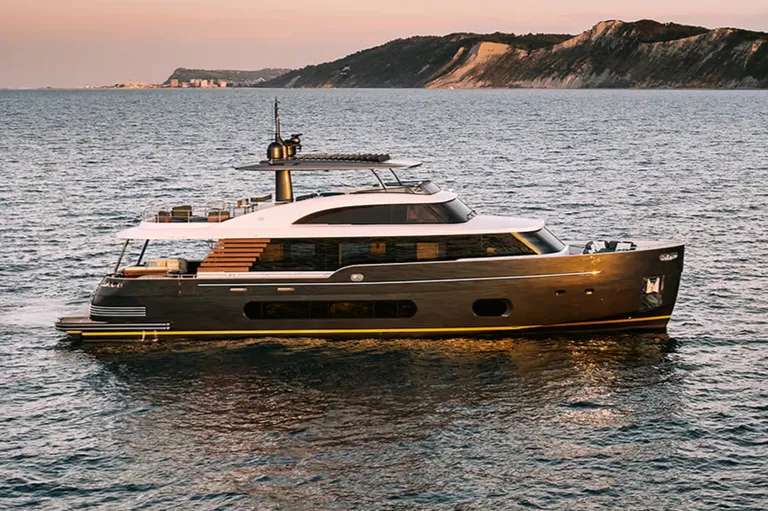
Slow cruising sounds like a philosophy, and it is usually sold as one. It is also, less romantically, an engineering decision — and once you look at the numbers, the philosophy tends to follow on its own.
The economics of eight knots
Take the Azimut Magellano 60, the most accessible boat in the series. Azimut publishes consumption figures that make the case better than any brochure copy:
- At ten knots it uses around six litres per nautical mile.
- In displacement mode, consumption never exceeds nine litres per nautical mile.
- At twenty knots that rises to about ten litres per mile, for a range of roughly 365 nautical miles.
- At ten knots the range is about 600 nautical miles; at eight knots and a relaxed 1,000 rpm it approaches 1,000.
That is the whole argument in one line: dropping from twenty knots to ten roughly triples how far the same tank will take you. On this coast that is the difference between a day trip and a passage.
What a Dual Mode hull actually is
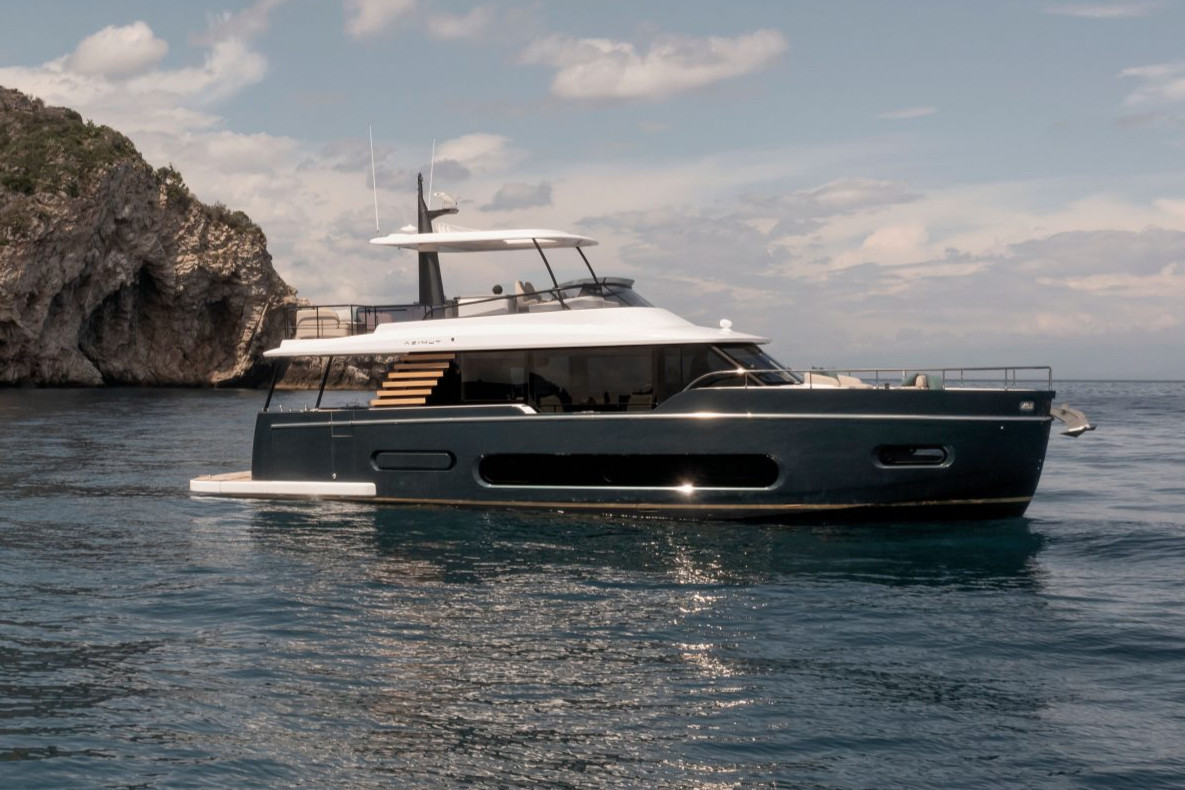
The Magellano’s underwater lines trace back to the naval architect Bill Dixon, who drew the original Magellano 43. The idea was to stop treating displacement and planing hulls as opposites: a deep-V forward section to cut into a sea, very shallow deadrise aft, wide chines, and a soft section amidships that works like a shock absorber.
The result behaves as a full-displacement boat at six to seven knots, and moves into semi-displacement mode at around sixteen — without the slamming of a planing hull at low speed or the wallowing of a pure displacement hull when you want to get somewhere. Azimut’s second-generation Dual Mode hull, fitted to the Magellano 60, is quoted at at least 20 % lower fuel consumption than a shaft-line boat of the same weight and size on a conventional hard-chine hull.
The Magellano range in numbers
| Magellano 60 | Magellano 25M | Magellano 30M | |
|---|---|---|---|
| Length | 60.6 ft | 82.74 ft | 97.44 ft |
| Beam | 16.9 ft | 20.67 ft | 23.16 ft |
| Draft | 4.49 ft | 6.23 ft | 6.75 ft |
| Cabins | 3 + 1 crew | 4 + 2 crew | 5 + 3 crew |
| Engines | 2 × MAN i6 | 2 × MAN V12 | 2 × MAN V12 |
| Power | 1,460 hp | 2,800–3,100 hp | 3,100–3,800 hp |
| Max / cruising speed | 26 / 18 kn | 25 / 19 kn | 24 / 18 kn |
| Fuel | 3,650 L | 8,100 L | 14,500 L |
| CE category | B | A | A |
Note the CE categories. The 25M and 30M are category A — ocean — which is what turns ‘slow cruising’ from a weekend habit into genuine range.
Slow cruising on this coast
The geography here rewards it. From Cartagena, the Rosario Islands are a short run southwest — close enough to leave after breakfast and be at anchor before midday. Keep going south and the San Bernardo islands open up. Head northeast and you reach Santa Marta and the Tayrona coast. In Panama, Las Perlas sits about 45 nautical miles from the city.
None of those legs need twenty knots. All of them are better at eight, with the generator off, coffee still hot and the flybridge actually usable — which is the point. We have collected the best of them in five anchorages worth the sail.
Try it at eight knots
The only convincing way to understand a Dual Mode hull is to sit on one at displacement speed for a couple of hours. We arrange Magellano sea trials from Cartagena and Panama. Write to ventas@elite-yachts.com.